
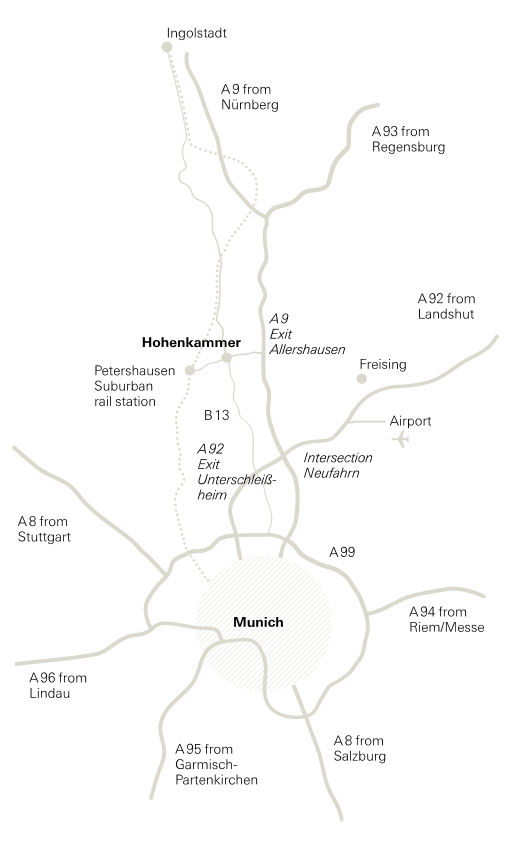
By car – arriving from North and South:
From the South take the A9 in the direction of Ingolstadt/Nürnberg/Berlin; from the North take the A9 in the direction of Munich. Exit the A9 at junction Allershausen (67) and follow the signs to the left in the direction of Hohenkammer. Leave the roundabout at the second exit and follow the road, via Eglhausen, to Hohenkammer. At the end of the road, at Hohenkammer, turn right onto the B13 in the direction of Ingolstadt. Follow the main road past the church and then turn left onto Petershauser Straße. You will reach Schlossstraße on the right after 100 metres. Parking spaces are located directly after the bridge on your left.
By car – arriving from the airport:
Leave the airport and get onto the A92 in the direction of Eching/Munich. Change over to the A9 in the direction of Ingolstadt/Nürnberg/Berlin at the motorway intersection Neufahrn. Exit the A9 at junction Allershausen (67) and follow the above directions.
By taxi:
The taxi ride from Munich’s Central Station to Hohenkammer costs approximately 120 euros. Visitors should calculate 95 euros for a trip from the airport.
By train:
Take the suburban rail, S2, from Munich’s Central Station in the direction of Ingolstadt and get off at Petershausen. Schloss Hohenkammer is just a few kilometres from Petershausen and easy to reach by taxi.
Petershausen station:
There are no taxis waiting. For reservations call
City Taxi
Phone +49 (0)171 48 07 508
Taxi Ilm
Phone +49 (0)160 26 01 661
or our reception
Phone +49 (0)8137 93 40
Parking (5.00 euros per day):
250 parking spaces
10 bus parking spaces
7 seminar trainer parking spaces
3 handicapped parking spaces
and
5 electric filling stations
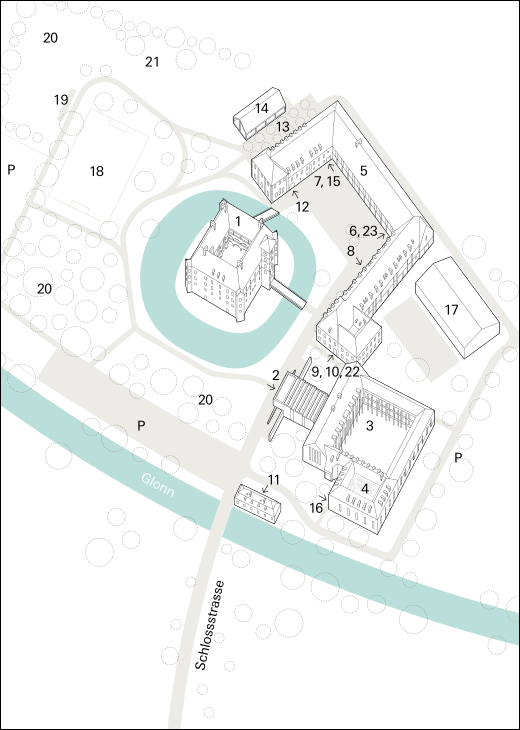
1 Castle:
Ground floor:
Klausur 1 + 2
Großes Gewölbe
Camers
Schloßstüberl
Zirbelstube
1st floor:
Klausur 3 – 5
Kleines Gewölbe
Kapelle
Thalhausen
Scagliolazimmer
Stuckzimmer
Schloßsaal
2nd floor:
Wappenzimmer
Reichertshausen
Barockzimmer
Klausur 6
Turm der Ideen
Weihenstephan
Kammerberg
Studio 1
3rd floor:
Giebinger Forst
2 Hotel:
2.1 Reception
Rooms
Wellness, sauna
and fitness
Garden
3 Brückenhaus:
Rooms
Kaminzimmer
Benonia, Haslang
Atrium
4 Gutshof:
4.1 Rooms
Werkstatt für Neues
4.2 Gutshof-Foyer
4.3 Gutshof-Saal
5 Altes Försterhaus:
Glonnblick
Durchblick
Rooms
Gastronomy:
4.2 Gutshof-Restaurant
4.3 Alte Galerie
4.4 Cotta-Saal, Cotta-Bar
and Club room
4.5 Biergarten am Schlosspark
2.2 Haslangkeller, Patio
6 Eventhalle
7 Outdoor:
7.1 Football pitch
7.2 Boules pit
7.3 Schlosspark
7.4 Children’s playground
P Parking spaces
Here you will find pictures of Schoss Hohenkammer at your disposal:
Background images (1920 x 1080px)
Schloss Hohenkammer GmbH
Schlossstrasse 20
85411 Hohenkammer, Germany
Phone +49 (0)8137 93 40
Fax +49 (0)8137 93 43 90
E-mail
Managing directors: Martin Kirsch,
Dr. Anne Wiese
Registered office: Hohenkammer
Munich local court: HRB 124877
Value Added Tax number: DE-226887443
Disclaimer
Copyright:
Texts, images and diagrams, including the design of the Schloss Hohenkammer website, are subject to copyright and other protection laws. They may be used, in part or in their entirety, only for personal, not commercial, use. Should the contents or parts of the Schloss Hohenkammer website be stored with the appropriate authorisation, reference must be made to Schloss Hohenkammer GmbH’s copyright. The reproduced images, diagrams and articles of the Schloss Hohenkammer website may be subject to the copyrights of a third party.
Trademarks:
Company names, company logos and product names, as well as all other appellations, logos and names that appear on the Schloss Hohenkammer website, may be trademarks of the respective owners.
Exclusion of liability and reservation of right:
Schloss Hohenkammer GmbH has compiled all information and features of this website to the best of its knowledge and belief. Nevertheless it shall assume no guarantee whatsoever for the currency, correctness, completeness or quality of the information provided on this site. Liability claims against Schloss Hohenkammer GmbH for possible damages caused by viruses through the retrieving or downloading of data from this site shall always be excluded. In addition, Schloss Hohenkammer GmbH maintains the right at any time and without prior warning to make changes or additions to the information and features contained in this website.
Reference (hyperlinks) to third party websites:
By clicking on certain references (hyperlinks) on the Schloss Hohenkammer website, you may exit this site. The content and design, as well as possible changes to the website referred to on the Schloss Hohenkammer website, are not subject to the influence or control of Schloss Hohenkammer GmbH. Schloss Hohenkammer GmbH therefore is not liable for the content of any linked website that is referred to on its website or, furthermore, for any other references to other website on such linked websites.
© Copyright 2026
Schloss Hohenkammer GmbH
All rights reserved
Design:
Keller Maurer Design
Programming:
Michael Brater
Photography:
Sindia Boldt
Karin Brunner
Orla Connolly
Marina Eichner
Angelika Harrer
Michael Heinrich
Oliver Jung
Introduction
Section 1 – Information on the collection of personal data
Section 2 – Your rights
Section 3 – Collection of personal data when visiting our website
Section 4 – Contact form
Section 5 – Further functions and offers of our website
Section 6 – Objection to the processing of your data or revocation
Section 7 – Apps
Section 8 – Use of Google Analytics
Section 9 – Plug-ins
Schloss Hohenkammer GmbH (SH) is pleased about your visit to our website, the use of our mobile applications and your interest in our company. We take the protection and security of your personal data seriously, and we want you to feel safe and comfortable when visiting our websites or making use of our offers.
(1) We should like to inform you as follows about the collection of personal data when using our website. Personal data is all data which can be personally related to yourself, e.g. name, address, e-mail-addresses, user behaviour.
(2) The controller as defined by Art. 4 para. 7 EU General Data Protection Regulation (GDPR) is
Schloss Hohenkammer GmbH
Schlossstraße 20
D-85411 Hohenkammer
Phone +49 (0)8137 93 40
Fax +49 (0)8137 93 43 90
E-mail
(see our Legal notice).
You can contact our data protection officer at E-mail or using our postal address, adding the reference “der Datenschutzbeauftragte” (the data protection officer).
(3) If you get in touch with us by e-mail, we will store the data you provide (your e-mail address, possibly your name and telephone number) in order to respond to your queries. We then erase the data which comes about in this context once storage is no longer necessary, or restrict processing where subject to legal obligations of data retention.
(4) If we engage service providers for individual functions of our offering or wish to use your data for advertising purposes, please see below for detailed information about the relevant operations. In this context we also indicate the specified criteria for the duration of storage.
(1) You have the following rights vis-à-vis ourselves as regards personal data relating to you:
(2) You have also the right to lodge a complaint with a supervisory authority for data protection regarding the processing of your personal data by ourselves.
(1) If you merely use the website for information purposes, i.e. without registering or otherwise transmitting information to ourselves, we will collect only the personal data transmitted to our server by your browser. Where you wish to view our website, we collect the following data, which is required by ourselves in technical terms to display our website to you and to ensure its stability and security (legal basis: Art. 6 para. 1 s. 1 point (f) GDPR):
(2) In addition to the data specified above, we also store cookies on your computer whenever you use our website. Cookies are small text files which are stored on your computer's hard disk in association with the browser you use. They transmit specific information to the party placing the cookie (in this case, ourselves). Cookies cannot execute programs or place viruses on your computer. Their purpose is to make our Internet site overall more user-friendly and effective.
(3) Use of cookies:
a) This website uses the following types of cookies, whose scope and functioning is explained below:
b) Transient cookies are deleted automatically when you close your browser. They in particular include session cookies. They store what is known as a session ID, which allows different requests from your browser to be grouped into a joint session. This means your computer will be recognised if you return to our website. Session cookies are deleted when you log out or close the browser.
c) Persistent cookies are deleted automatically after a specified period of time, which may vary depending on the cookie. You can delete cookies in the security settings of your browser at any time.
d) You can configure your browser settings as you wish, for instance, refuse to accept third-party or all cookies. We must point out here that you may then possibly be unable to use all functions of this website.
If you us send us requests using the contact form, your information from the enquiry form will be stored by ourselves. This includes the contact data you provided in it, for the purpose of dealing with your request and in the event of further questions. We will not pass on this data without your consent.
The data entered in the contact form will thus be processed solely on the basis of your consent (Art. 6 para. 1 point (a) GDPR). You can revoke this consent at any time. It is sufficient here to notify us in an e-mail without any set form. The lawfulness of the data processing operations which took place prior to revocation remain unaffected by such revocation.
We will hold the data you entered in the contact form on file until you ask us to erase it or revoke your consent to storage, or until the purpose of data storage no longer applies (e.g. once processing of your request is complete). Mandatory statutory provisions – in particular the periods for data retention – remain unaffected here.
(1) Besides the utilisation of our website purely for information purposes, we also offer various services which you can use where of interest to you. To this end, you must generally specify further personal data, which we will use to provide the relevant service and which is subject to the principles for data processing described above.
(2) In some cases we use external service providers to process your data. They have been carefully selected and instructed by ourselves, are bound by our directions and are subject to regular monitoring and control.
(3) We may furthermore pass on your personal data to third parties where we offer participation in campaigns or competitions, the conclusion of contracts or similar services together with partners. You can obtain further information in this regard on specifying your personal data or below in the description of the offer.
(4) Where our service providers or partners are based in a state outside the European Economic Area (EEA), we will inform you about the consequences of this circumstance in our description of the offer.
(1) Where you have consented to the processing of your data, you can revoke this at any time. Once you have notified us, such revocation will affect reliability as regards processing of your personal data.
(2) Where we base processing of your personal data on the evaluation and balancing of interests, you can object to processing. This is the case where processing is in particular not necessary to execute a contract with you, something that we indicate with each following description of the functions. Where you make such objection, please be so kind as to state the grounds why you do not wish us to process your personal data as would be performed by ourselves. In the case of a legitimate objection on your part, we will review the individual situation. We will then either cease or adapt the processing of your data or demonstrate compelling legitimate grounds that form the basis for continued processing by ourselves.
(3) You may of course object to the processing of your personal data for the purposes of advertising and data analysis at any time. You can us notify us of your objection to such advertising using the following contact details:
E-mail
Schloss Hohenkammer GmbH
Der Datenschutzbeauftragte
Schlossstraße 20
D-85411 Hohenkammer
These services are specifically designed for mobile devices (such as smartphones). Some of this content is downloaded from other sources (mainly for reasons of timeliness of data). Functions are generally executed on the mobile device. When we call functions on SH servers, we delete this data there after it has been transmitted. We process personal data only when it is necessary for the purpose of the app or if you have given us your explicit consent to do so. A transfer of data to third parties does not occur. Personal data will not be transferred to a third party. We reserve the right to make anonymous analysis of the data for statistical purposes.
Geodata is used for localisation services. We do not combine this geodata with your personal data, but use it only for the purpose of localisation within the app or subfunction of an app you have requested. We discard this geodata after localisation. Regardless of which end device you use, you can also switch off the geolocation option in general (see the manufacturer’s information for your end device). However, you will then not be able to use the app’s localisation function.
Data is also stored on your end device. Personal data is always saved in encrypted form; some data is also saved in non-encrypted form. If your end device is lost, misuse by third parties cannot be ruled out. We therefore recommend that you use the device-specific measures to protect against misuse (encryption, usage block etc.). Please see the manufacturer’s information for your end device. When passing on your end device, for example in the form of a sale, you should use all the options for removing personal data from your end device.
This website uses the “Google Analytics” service provided by Google Inc. (1600 Amphitheater Parkway Mountain View, CA 94043, USA) to analyze website usage by users. The service uses “cookies” – text files that are stored on your end device. The information collected by the cookies is usually sent to a Google server in the USA and stored there.
IP anonymization takes effect on this website. The IP address of the user is shortened within the member states of the EU and the European Economic Area. This shortening eliminates the personal reference to your IP address. As part of the agreement on the order data agreement, which the website operators have concluded with Google Inc., Google Inc. uses the information collected to evaluate website usage and website activity and provides services related to internet usage.
You have the option of preventing the storage of cookies on your device by making the appropriate settings in your browser. There is no guarantee that you will be able to access all functions of this website without restrictions if your browser does not accept cookies.
You can also use a browser plug-in to prevent the information collected by cookies (including your IP address) from being sent to Google Inc. and used by Google Inc. The following link takes you to the corresponding plugin:
Link
Here you will find further information on the use of data by Google Inc.:
Link
1. Facebook “Like” button
(1) Our website incorporates plug-ins for the social networking site Facebook, provided by Facebook Inc., 1 Hacker Way, Menlo Park, California 94025, USA.
(2) Facebook plug-ins are indicated by the Facebook logo or the “Like” button appearing on our page.
(3) You can find an overview of Facebook plug-ins here.
(4) When you visit our site, the plug-in creates a direct link between your browser and the Facebook server. This informs Facebook that you visited our site with your IP address.
(5) If you click on the Facebook “Like” button while logged into your Facebook account, you can link the contents of our pages to your Facebook profile.
(6) This enables Facebook to associate your visit to our site with your user account.
(7) We should like to point out that we, as the provider of the pages, have no knowledge of the contents of the data transmitted and its use by Facebook.
(8) You can find further information in this regard in Facebook’s privacy statement.
(9) If you not want Facebook to be able to associate your visit to our site with your Facebook user account, please make sure you log out of your Facebook user account.
2. Twitter plug-in
(1) Functions of the Twitter service are incorporated in our pages.
(2) These functions are provided by Twitter Inc., 1355 Market Street, Suite 900, San Francisco, CA 94103, USA. The use of Twitter and the “Re-Tweet” function links the websites you visit to your Twitter account and notifies other users of this.
(3) Data is also transferred to Twitter here.
(4) We should like to point out that we, as the provider of the pages, have no knowledge of the contents of the data transmitted and its use by Twitter.
(5) You can find further information in this regard in Twitter’s privacy statement.
(6) You can change your data protection settings for Twitter in your account settings.
3. YouTube
(1) Our website uses plug-ins from the YouTube site operated by Google. The operator of these pages is YouTube, LLC, 901 Cherry Ave., San Bruno, CA 94066, USA.
(2) If you visit one of our pages with a YouTube plug-in, this will create a link to the servers of YouTube. The YouTube server will be informed which of our pages you visited.
(3) If you are logged into your YouTube account, you will allow YouTube to directly associate your surfing behaviour with your personal profile. You can prevent this by logging out of your YouTube account.
(4) The usage of YouTube takes place in the interest of ensuring appealing presentation of our online offering. This represents a legitimate interest as defined by Art. 6 para. 1 (f) GDPR.
(5) You can find further information about the handling of user data in YouTube’s privacy statement.
4. OpenTable
Changes to privacy policy
Schloss Hohenkammer GmbH reserves the right to update this privacy policy if necessary in order to accommodate changes of website content and general legal changes.
Contact information
Schloss Hohenkammer GmbH looks forward to all feedback regarding this data privacy notification. Should you have any questions or comments regarding data privacy, please contact our privacy officer
Mr. Sascha Tischendorf
PRIOLAN GmbH
Steinsfeldstraße 46
74626 Bretzfeld, Germany
E-mail
This Accessibility Statement applies to the website of Schloss Hohenkammer GmbH at schlosshohenkammer.de.
Schloss Hohenkammer GmbH is committed to making its website accessible. The aim is to continuously improve the website in accordance with the legal provisions implementing Directive (EU) 2016/2102 on the accessibility of the websites and mobile applications of public sector bodies.
This website is largely compatible with the requirements of the Behindertengleichstellungsgesetz (BGG & LGG), the Barrierefreie-Informationstechnik-Verordnung (BITV) as well as the Web Content Accessibility Guidelines (WCAG) 2.2.
The following content is currently only partially accessible:
This declaration was created on 30 May 2025. It is based on an automated test according to the WCAG 2.2, conducted with accessibilitychecker.org.
Last review: 3 June 2025
The website is based on an extensive technical structure that was developed in 2018. Complete accessibility has not yet been achieved. We are continuously identifying and removing existing barriers.
We want our website to be as accessible as possible. If you encounter any barriers or have any suggestions for improvement, let us know.
Please get in touch via:
E-mail
Mailing address:
Schloss Hohenkammer GmbH
Schlossstraße 20
85411 Hohenkammer
If you do not receive a satisfactory response to your feedback, you can contact the conciliation body in charge. It mediates conflicts between people with disabilities and public bodies regarding digital accessibility. The procedure is free of charge and legal assistance is not required.
Conciliation body contact:
Schlichtungsstelle BGG
bei der Beauftragten der Bundesregierung für die Belange von Menschen mit Behinderungen
Mauerstraße 53
10117 Berlin
schlichtungsstelle-bgg.de

|
I agree that by clicking the „OK“-button a connection will be established to the YouTube server and that personal data will be transmitted to YouTube (e.g. IP address).
